

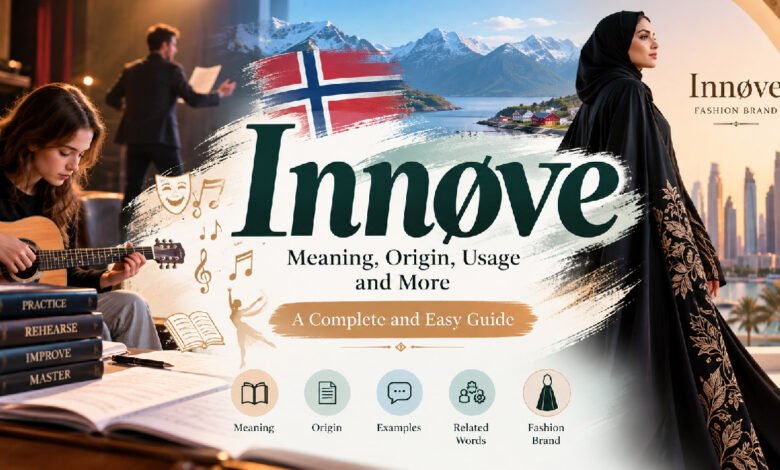
Innøve is a Norwegian word used when someone practices or rehearses something repeatedly until they learn it well. It can describe preparing a role, speech, musical piece, dance movement, routine, or another skill. The main idea behind the word is repeated and focused practice.
The term can be confusing because Innøve appears in other contexts online. It is also the name of a Qatari fashion brand associated with abayas and contemporary modest fashion. In addition, some online articles describe Innøve as an AI or digital transformation platform, although clear supporting information for those technology claims remains limited.
Understanding the context is therefore important. This guide explains the Norwegian meaning of Innøve, its origin, spelling, grammar, pronunciation, examples, and related words. It also covers its practical uses, the separate fashion brand, and why technology-related descriptions should be treated carefully.
What Does Innøve Mean?
Innøve is a Norwegian verb that means to practice or rehearse something repeatedly so that it becomes familiar and well learned. In English, the best translation is often “practice” or “rehearse.” In certain situations, words such as “train” or “drill” may also express a similar idea.
The important part of Innøve is purposeful repetition. An actor can innøve a role before appearing on stage. A speaker can innøve a speech before an important event. A musician can repeatedly practice a difficult musical piece until it can be performed correctly and confidently.
Innøve is therefore more specific than simply learning something. Learning can happen through reading, listening, observation, or explanation. Innøve focuses on the repeated practice used to make knowledge, movements, words, or actions familiar enough to perform them reliably when they are needed.
Origin and Etymology of Innøve
The Norwegian word Innøve can be understood through two parts: inn and øve. The verb øve means to practice or exercise. When combined in Innøve, the word expresses the more specific idea of practicing something until it has been learned, prepared, or established through repetition.
The word also has a linguistic connection with the German verb einüben. The German term carries a similar idea of learning, practicing, or rehearsing something through repeated exercises. This connection helps explain the traditional linguistic background of the Norwegian word and its focus on deliberate practice.
This origin is important because Innøve can look unusual to English readers. It may even remind some people of “innovate” or “innovation.” These words do not share the same meaning. The Norwegian Innøve concerns practice and rehearsal, while innovation concerns introducing or developing something new.
Why the Letter Ø in Innøve Matters
The letter ø in Innøve is not a decorative symbol added to make the word look unusual. It is a real letter used in the Norwegian alphabet. It also appears in some other Scandinavian languages and represents a sound that does not have a perfect direct equivalent in standard English.
Keeping the ø is useful when discussing the Norwegian word because it preserves the correct spelling. Writing “Innove” can make the term look closer to English words connected with innovation. That similarity can cause readers to misunderstand what the original Norwegian verb actually means.
English speakers should therefore recognize Innøve as a Norwegian word rather than treating its spelling as a stylized form of an English term. The presence of ø provides an immediate clue about its Scandinavian language background and helps distinguish the established verb from unrelated names or concepts.
Innøve Pronunciation and Grammar
Innøve is a verb, so its form can change depending on how it functions in a Norwegian sentence. The infinitive is å innøve, meaning “to practice” or “to rehearse.” Its present-tense form is innøver, while recorded past forms include innøva and innøvde.
Past-participle forms include innøvd and innøvet, while the imperative is innøv. The present participle is innøvende. Different accepted forms can occur depending on grammatical context and written language variation. Learners do not need to memorize every form immediately to understand the basic meaning.
One pronunciation representation found in the supplied information is [i´n:øvə]. The Norwegian ø should not simply be pronounced like an ordinary English “o.” Because English does not normally contain the same vowel sound, listening to a native Norwegian pronunciation can provide a clearer understanding than relying entirely on English spelling.
Examples of Innøve in Norwegian
Simple examples make the meaning of Innøve much easier to understand. Innøve en rolle means “to rehearse a role.” An actor might rehearse dialogue, movements, expressions, and timing repeatedly before performing a character in front of an audience.
Another useful expression is innøve en tale, meaning “to rehearse a speech.” A speaker might repeat the speech several times to remember its structure and become comfortable delivering it. The phrase innøvde dansetrinn can refer to dance steps that have already been practiced or rehearsed.
A longer example is Teatergruppa har innøvd et nytt stykke, which means that the theatre group has rehearsed a new play. The most natural English translation can change according to context. Actors usually rehearse roles, while musicians commonly practice pieces, although both activities express the central idea behind Innøve.
Innøve vs. Øve, Trene, and Repetere
Innøve is related to several Norwegian words, but they should not always be treated as exact synonyms. Øve is a broader word meaning to practice or exercise. Someone can øve regularly without necessarily suggesting that one particular performance, routine, or action is being mastered completely.
Innøve is more specific because it usually focuses on practicing a particular thing until it becomes familiar or ready for use. Trene, meanwhile, generally means “to train” and is commonly associated with sports, physical exercise, and developing abilities through training. The exact choice depends on context.
Repetere means to repeat or review. A student, for example, may review previously studied material before an examination. Repetition can be part of Innøve, but Innøve normally has a stronger purpose: repeated practice is being used to learn or master something rather than merely repeating it.
How Innøve Works as a Learning Process
The idea behind Innøve is closely connected with learning by doing. A person first attempts a task, notices difficulties or mistakes, makes corrections, and tries again. Repeating this process can gradually make an unfamiliar action easier to remember and more comfortable to perform.
Effective practice involves more than repeating the same action without thought. If someone repeatedly makes the same mistake without recognizing it, repetition can reinforce poor technique. Useful practice therefore involves attention, correction, and feedback as well as repetition. Teachers, coaches, directors, recordings, or personal observation can provide that feedback.
Over time, repeated and corrected practice can improve familiarity and performance. Something that initially requires considerable attention may become easier after sufficient practice. This explains why the meaning of Innøve fits activities such as acting, music, dance, presentations, workplace procedures, and other skills requiring reliable performance.
Innøve in Music, Theatre, and Dance
Music, theatre, and dance provide some of the clearest situations for understanding Innøve. Actors rehearse lines, movements, timing, and complete scenes before a performance. A difficult section may need to be repeated many times before everyone involved can perform it consistently.
Musicians follow a similar process. A musician can practice difficult sections of a musical piece separately before performing the complete work. Bands, orchestras, and choirs also rehearse together so individual performers can coordinate timing, rhythm, volume, and other elements of a group performance.
Dance also depends heavily on repeated practice. Dancers may rehearse individual steps, longer sequences, formations, timing, and complete routines. In all these cases, the person is not simply learning information. They are repeatedly performing something so that it becomes familiar enough to reproduce successfully during the final performance.
Innøve in Education, Sports, and Everyday Life
The idea expressed by Innøve also applies to education. Students may understand an explanation but still need practical exercises before they can use that knowledge confidently. Language learners, for example, can practice pronunciation, speaking, presentations, reading aloud, and sentence construction repeatedly to improve their abilities.
Sports provide another useful example. A football player might repeatedly practice a particular passing technique, while a basketball player can work on a specific shooting movement. The broader Norwegian word trene is common for general sports training, while Innøve can be useful when referring to practicing a specific movement, routine, or technique.
Similar practice happens in ordinary life and workplaces. Employees may repeatedly practice using equipment, software, procedures, presentations, or customer-service processes. Cooking, driving, typing, writing, and speaking can also improve through practice. Knowing how something works and being able to perform it reliably are not always the same thing.
Innøve vs. Innovate
Innøve and “innovate” may look somewhat similar to an English reader, especially if the Norwegian ø is removed. Their meanings, however, are completely different. Innøve means practicing or rehearsing something, while innovate means developing or introducing a new idea, product, process, or method.
A simple business example shows the distinction. A company might innovate by developing a new working process or introducing new technology. Employees could then need to practice the new procedure repeatedly before they become comfortable using it. Innovation created the change, while practice helped people learn how to use it.
This distinction also explains why interpretations connecting the Norwegian word itself with innovation should be treated carefully. Businesses are free to use Innøve as a brand and create their own meaning around the name, but a commercial interpretation does not replace the established linguistic meaning of the Norwegian verb.
Innøve in Norwegian and Other Scandinavian Languages
Innøve belongs to Norwegian, a language with two official written standards, Bokmål and Nynorsk. Word forms can vary according to the written standard and grammatical context. This is one reason learners may encounter more than one accepted past-tense or participle form while researching the verb.
Related expressions can also be found in neighboring Scandinavian languages. Danish uses indøve for a similar idea involving learning or rehearsing something through practice. Swedish can communicate a comparable idea using öva in. The resemblance is understandable because Norwegian, Danish, and Swedish are closely related languages.
However, similar-looking words should not automatically be treated as identical. Each language has its own spelling, pronunciation, grammar, and usage conventions. For Norwegian learners, the most useful approach is to understand Innøve within Norwegian first and use appropriate Norwegian dictionaries when checking particular grammatical forms or sentence structures.
Why Innøve Has Different Meanings Online
Searching for Innøve can produce confusing results because the same spelling can appear in unrelated contexts. The established Norwegian meaning concerns practice and rehearsal, but existing words can also become names for businesses, websites, products, fashion labels, or other commercial projects.
A brand using Innøve does not automatically share the history or meaning of the Norwegian verb. Companies often choose names because they sound memorable or because the business can create a particular identity around them. This can result in search pages where linguistic information and commercial information appear beside each other.
Context is therefore essential. References to roles, speeches, music, dance, rehearsal, or Norwegian grammar usually concern the verb. References to abayas and fashion concern a separate brand. Technology descriptions involving AI, automation, and cloud computing represent another online use that needs stronger verification before detailed product claims are accepted as fact.
Innøve as a Qatari Fashion Brand
Innøve is also used as the name of a Qatari fashion brand focused mainly on abayas and contemporary modest fashion. This commercial use should be kept separate from the Norwegian verb. Available information describes designs combining traditional modest-fashion forms with modern fabrics, cuts, embroidery, lace, and contrasting details.
Collections mentioned in the supplied material include Made To Remain, The Classic Line, FW 2025, SS 2025, Pre-Fall 2024, and Summer 2024. Reported designs include Deva, Edge, Lulu, Her Essential, AlgHaid, Athar, Auburn, Blanca, Celeste, Comet, and Contour. A linen kaftan called Velura is also mentioned.
The brand gives Innøve its own interpretation, connecting “Ínno” with innovation and “ve” with evolution and vision. This explanation belongs to the brand identity and should not be presented as Norwegian etymology. Hanan Al-Emadi is associated with Innøve through a signed message, although the supplied information does not establish a complete biography or precise ownership history.
Innøve Abayas, Materials, Sizes, and Prices
The reviewed Innøve catalog information mainly features abayas with different styles and details. Her Essential is described as a simple black flared design with a front zipper. Deva combines black linen with purple embroidery and deep-red lining, while Edge pairs a black exterior with an ivory inner lining.
Lulu is described as including lace details, a cream lining, and a matching scarf. Materials reported across different products include linen, taffeta, Escada material, and Morocco material. Some designs were available from XS through XXL, while common length choices were approximately 50 to 60 inches. Certain products recommend dry cleaning.
Many reviewed abayas were listed at roughly 700 to 900 QAR. Her Essential and Edge were reported at 700 QAR, Deva at 850 QAR, and Lulu at 800 QAR. These figures should be understood as catalog prices at the time reviewed rather than permanent prices because stock, collections, sizing, and pricing can change.
Is Innøve an AI or Digital Transformation Platform?
Some online descriptions present Innøve as a digital transformation platform involving automation, artificial intelligence, analytics, cloud technology, data management, dashboards, collaboration, and connected business workflows. Other claims mention machine learning, predictive analytics, document processing, intelligent search, and workflow optimization as possible capabilities.
The problem is that the supplied information does not provide enough clear primary documentation to establish these claims as confirmed product features. Important details remain unclear, including the developer or company, founder, headquarters, launch date, pricing, supported devices, system requirements, public API, named integrations, customer case studies, and independent reviews.
Security claims also require caution. Online descriptions mention encryption, multi-factor authentication, access controls, backups, monitoring, and audit logs, but specific certifications and detailed technical documentation have not been established in the supplied material. For this reason, technology-related claims about Innøve are better described as unconfirmed rather than presented as established facts.
How to Identify the Correct Meaning of Innøve
The easiest way to understand Innøve is to examine the surrounding context. If a Norwegian sentence discusses practicing a role, preparing a speech, rehearsing music, learning dance movements, or mastering a specific routine, the word is almost certainly being used as the Norwegian verb.
If the discussion includes abayas, modest clothing, collections, fabrics, garment sizes, scarves, or prices in QAR, Innøve is probably referring to the Qatari fashion brand. In this context, descriptions involving innovation, evolution, and vision relate to the brand’s chosen identity rather than the dictionary definition of the Norwegian word.
Technology-related results require greater care. Pages discussing AI, automation, cloud systems, dashboards, or digital transformation may use Innøve as a platform name or concept. Readers should look for official company details, technical documentation, pricing, privacy policies, security information, and verified product evidence before accepting detailed claims.
Final Thoughts
Innøve is primarily an established Norwegian verb meaning to practice or rehearse something repeatedly until it becomes learned and familiar. Its meaning is particularly useful in contexts involving theatre, music, dance, speeches, routines, and specific skills that require deliberate practice before they can be performed reliably.
The word should not be confused with innovate. Its ø is a genuine Norwegian letter, and related Norwegian words such as øve, trene, and repetere have overlapping but different uses. Understanding these distinctions gives language learners a clearer picture of when Innøve is the appropriate word.
The same name is separately used by a Qatari modest-fashion brand known mainly for abayas. Technology-related descriptions of an Innøve AI or digital transformation platform also exist online, but important details remain unconfirmed in the supplied information. Context is therefore the simplest way to identify which meaning is intended.
(FAQs)
What does Innøve mean in English?
Innøve is a Norwegian verb that means to practice or rehearse something repeatedly until it is learned well. It is commonly used for roles, speeches, music, dance movements, routines, and other skills that require repeated practice.
What is the difference between Innøve and øve?
Øve generally means to practice or exercise, while Innøve is more specific. Innøve usually describes practicing a particular role, movement, speech, musical piece, or routine repeatedly until it becomes familiar and ready to perform.
How do you pronounce Innøve?
Innøve can be represented approximately as [i´n:øvə]. The Norwegian letter ø has a vowel sound that does not have an exact equivalent in standard English, so hearing a native Norwegian speaker is helpful for learning its pronunciation.
Is Innøve the same as innovate?
No. Innøve and innovate have different meanings. Innøve is a Norwegian word connected with practice and rehearsal, while innovate means to develop or introduce something new. Their similar appearance can sometimes cause confusion among English speakers.
Is Innøve also a fashion brand?
Yes. Innøve is also used as the name of a Qatari fashion brand associated mainly with abayas and contemporary modest fashion. This brand is separate from the Norwegian verb, and its commercial interpretation of the name should not be confused with the word’s linguistic origin.





One Comment