

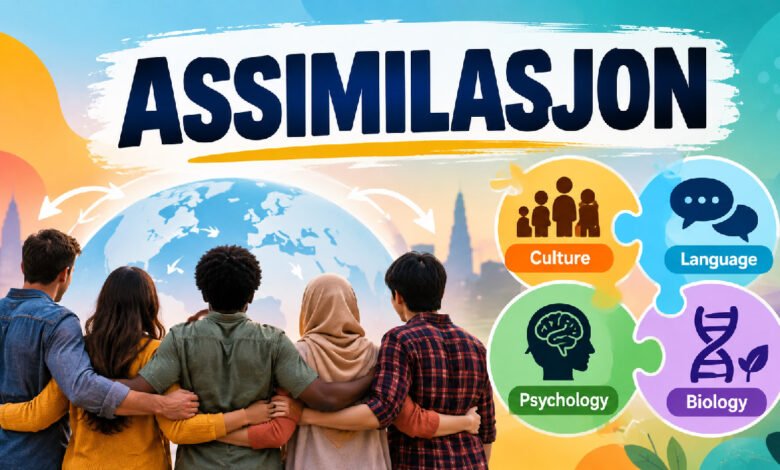
Assimilasjon is a Norwegian term closely related to the English word “assimilation.” It generally describes a process where something becomes similar to, fits within, or becomes incorporated into another system. However, its precise meaning changes considerably depending on the academic field.
The concept appears in sociology, linguistics, psychology, biology, education, and geology. In society, it can involve cultural adaptation. In language, it concerns changing speech sounds. In psychology, it explains learning. Biology uses the term when describing incorporation of substances.
Understanding these differences matters because the same word can describe processes that have very different consequences. Cultural assimilation involves people, identity, choice, and social power, while linguistic assimilation is primarily a natural feature of pronunciation occurring during everyday spoken communication.
This guide explains Assimilasjon in clear English, including its cultural, linguistic, psychological, and biological meanings. It also explores integration, forced assimilation, Norwegian history, sound changes, cognitive development, nutrient use, and practical examples that make each meaning easier to understand clearly.
What Does Assimilasjon Mean?
The simplest meaning of Assimilasjon is becoming similar or becoming incorporated into something that already exists. The term comes from the same linguistic background as English “assimilation.” What actually becomes similar or incorporated depends entirely upon the context involved.
In sociology, Assimilasjon can describe individuals or communities gradually adopting characteristics of another cultural group. Language, customs, values, social behavior, and everyday practices can change. The process may develop voluntarily through contact or occur because of institutional and social pressure.
In linguistics, the meaning is completely different. Assimilation happens when one speech sound develops characteristics of another nearby sound. Such pronunciation changes frequently make speaking smoother because the mouth can move between consecutive sounds with less physical effort during connected speech.
Other disciplines apply the same underlying idea differently. Psychology discusses new experiences being interpreted through existing mental structures. Biology concerns materials becoming incorporated into living systems. Geology can describe surrounding rock material becoming incorporated into magma beneath Earth’s surface over time.
Cultural Assimilasjon and Society
Cultural Assimilasjon describes a process through which individuals or groups adopt cultural characteristics associated with another group, particularly a socially dominant population. Changes can involve language, clothing, food, customs, values, education, relationships, celebrations, and patterns of everyday social behavior.
Cultural change rarely occurs at exactly the same speed in every part of someone’s life. A person might use the majority language professionally while speaking a heritage language at home. Local customs can similarly exist alongside inherited family traditions comfortably.
Migration often creates situations where cultural adaptation becomes particularly visible. New residents interact with schools, workplaces, government institutions, neighbors, and businesses. Through repeated contact, they may learn new expectations and practices while deciding which elements of their heritage remain important.
Assimilation therefore should not automatically be understood as complete cultural disappearance. People can adopt useful practices from the surrounding society while maintaining meaningful parts of their heritage. Modern identities are frequently layered, combining languages, traditions, experiences, and cultural influences together.
How Cultural Assimilasjon Happens
Language learning is one important pathway through which cultural Assimilasjon can develop. Learning a widely used local language can improve communication and provide easier access to employment, education, healthcare, government services, friendships, and participation within the wider community itself.
Schools can strongly influence cultural adaptation because children spend significant time interacting with teachers and classmates. They learn not only academic subjects but also communication styles, social expectations, language patterns, celebrations, and behavioral norms that are common within wider society.
Workplaces create another major point of cultural contact. Employees encounter professional expectations, workplace vocabulary, communication habits, schedules, and social conventions. Regular interaction with colleagues can gradually increase familiarity with cultural practices without necessarily replacing someone’s original identity or traditions completely.
Assimilation may become more noticeable across generations. Children and grandchildren of migrants can use the majority language more frequently than earlier generations. However, families may continue preserving heritage through food, religion, music, names, celebrations, stories, and connections with relatives.
Voluntary and Forced Assimilasjon
Voluntary Assimilasjon occurs when people freely adopt aspects of another culture because doing so provides personal, social, educational, or economic advantages. Someone might learn another language, develop new friendships, enjoy different foods, or participate in unfamiliar cultural celebrations willingly.
These choices do not necessarily require abandoning an earlier identity. Someone can become fluent in Norwegian, participate actively in Norwegian society, and simultaneously maintain another language and cultural traditions. Cultural adaptation can therefore involve addition rather than complete replacement of identity.
Forced assimilation involves fundamentally different circumstances. Authorities or powerful institutions may pressure minority communities to abandon their languages, customs, beliefs, names, or traditions. Historically, coercive measures have sometimes involved restrictive education systems, discriminatory policies, punishment, and unequal access to opportunities.
Consent therefore provides an essential distinction. Cultural exchange chosen by individuals differs substantially from policies designed to make communities conform. Forced assimilation can contribute to language decline, disrupted cultural transmission, damaged community relationships, discrimination, and long-lasting distrust toward public institutions.
Assimilasjon in Norwegian History
Norway provides an important historical context for understanding forced Assimilasjon. Norwegianization, commonly called fornorsking in Norwegian, refers to historical policies and practices intended to strengthen Norwegian language and culture among minority populations, particularly Sámi and Kven communities over time.
Education became an important instrument of Norwegianization. Norwegian received priority within schools, while minority languages faced restrictions or limited opportunities in different historical periods. Such conditions contributed to reduced transmission of some minority languages between older and younger generations in affected communities.
Norway established the Truth and Reconciliation Commission to investigate Norwegianization policies and injustices affecting Sámi, Kvens/Norwegian Finns, and Forest Finns. The Commission delivered its extensive report to the Norwegian Parliament, the Storting, on the first of June 2023 officially.
The historical experience demonstrates why cultural Assimilasjon cannot be discussed only as adaptation. Power, rights, discrimination, language policy, and freedom of choice also matter. Modern discussions increasingly emphasize cultural preservation, reconciliation, minority rights, participation, and opportunities for language revitalization today.
Assimilasjon vs Integration
Assimilasjon and integration are sometimes treated as interchangeable concepts, but they describe different approaches to cultural participation. Assimilation generally involves becoming increasingly similar to the majority culture, whereas integration emphasizes participation within society without necessarily abandoning an existing cultural identity.
An integrated person might learn the national language, attend school, work, vote, build friendships, and participate in local institutions while continuing to speak a heritage language, observe traditional celebrations, practice religious beliefs, or maintain other important family customs at home.
Multiculturalism presents another approach. It recognizes cultural diversity as a continuing feature of society rather than something expected eventually to disappear. Different communities can maintain distinctive languages, customs, foods, traditions, and identities while participating within the same political and economic system.
Real societies rarely follow only one model. Individuals can experience integration and partial assimilation simultaneously. People might adopt certain majority practices while maintaining others from their heritage. Cultural identity is therefore better understood as flexible and multidimensional rather than simply replaced entirely.
Assimilasjon in Linguistics
In linguistics, Assimilasjon refers to a phonological process where one speech sound becomes more similar to another sound. It frequently occurs during natural connected speech because neighboring sounds influence how speakers position their lips, tongue, jaw, and other articulators while talking.
Consider nasal sounds before consonants produced with the lips. An “n” can shift toward an “m” sound before sounds such as “p” or “b.” This adjustment places the mouth in a more convenient position for producing the following consonant smoothly.
Regressive assimilation occurs when a later sound influences an earlier one. Progressive assimilation works in the opposite direction, with an earlier sound influencing what follows. Linguists can also classify assimilation according to changes involving voicing, manner, or place of articulation.
Sound assimilation should not automatically be regarded as incorrect pronunciation. It is a common feature of spoken languages and can become established historically. Studying these patterns helps linguists understand connected speech, regional accents, dialect development, phonology, and long-term language change.
Assimilasjon in Psychology
Psychology gives Assimilasjon another specialized meaning. Developmental psychologist Jean Piaget used assimilation to describe how people understand new experiences through mental structures they already possess. These organized structures, commonly known as schemas, help people categorize and interpret information efficiently.
Imagine a child who already understands the category “dog.” When the child encounters an unfamiliar dog breed, the animal can still fit into the existing dog schema. The child therefore understands something new without needing to reconstruct the entire mental category.
Piaget distinguished assimilation from accommodation. Accommodation becomes necessary when existing knowledge cannot accurately explain a new experience. The learner must then modify an existing schema or develop another one. Both processes contribute to cognitive adaptation and increasingly sophisticated understanding over time.
For example, a child might initially classify every small furry four-legged animal as a dog. Encountering cats eventually requires a separate category. Assimilation first uses existing knowledge, while accommodation modifies that knowledge when evidence shows that the existing explanation is inadequate.
Assimilasjon in Biology
Biological Assimilasjon concerns the incorporation and use of substances by living organisms. It should be distinguished from digestion and absorption. Digestion breaks food into smaller components, while absorption transfers available nutrients into body fluids or tissues where they become usable.
After absorption, organisms can use nutrients for numerous biological purposes. Amino acids can contribute to protein production, while components derived from carbohydrates and fats enter metabolic pathways. These substances may support growth, tissue maintenance, energy storage, repair, and cellular functions.
Plants demonstrate assimilation particularly clearly. During carbon assimilation associated with photosynthesis, carbon dioxide provides carbon that is fixed into organic molecules. Plants ultimately use carbon-containing compounds to support growth and create carbohydrates and numerous other essential biological materials and structures.
Nitrogen assimilation is equally important. Plants acquire inorganic nitrogen, commonly including nitrate or ammonium, and convert nitrogen into organic compounds. Nitrogen eventually becomes incorporated into amino acids, proteins, nucleic acids, and other molecules required for normal plant growth and development.
Assimilasjon in Geology
Geology provides another scientific use of Assimilasjon. Magma moving or remaining beneath Earth’s surface can interact with surrounding country rock. Under appropriate conditions, material from those rocks may become incorporated into magma and consequently influence its overall chemical composition.
The surrounding material does not necessarily enter magma unchanged. Heating, melting, chemical reactions, and mixing can create complex interactions between magma and country rock. Geologists study these processes when investigating how particular igneous rocks and magmatic systems developed beneath Earth’s surface.
Geological assimilation shares the broad concept found in other definitions: existing material receives something from outside and incorporates it. However, geological Assimilasjon has no connection with cultural identity, language learning, psychology, or social integration despite using the same general terminology.
This example demonstrates why context remains essential whenever the keyword appears. Readers should identify the subject before interpreting its meaning. An article about magma uses Assimilasjon very differently from research discussing immigration, pronunciation, childhood learning, minority cultures, or biological nutrient processing.
Why Assimilasjon Matters Today
Assimilasjon remains relevant because modern societies are increasingly connected through migration, education, international employment, travel, entertainment, and digital communication. People encounter languages and cultural practices beyond their own communities regularly, creating new opportunities for adaptation, exchange, and mixed identities.
Digital platforms accelerate this process. Music, fashion, slang, food, humor, and entertainment can travel internationally within hours. Cultural influence therefore does not necessarily flow only from majority populations toward minorities. Communities continuously borrow, modify, and reinterpret cultural material from each other.
At the same time, governments and communities face important questions concerning social participation and cultural rights. Learning a shared language can improve communication, but protecting minority languages also matters. Participation within wider society does not inherently require cultural traditions to disappear entirely.
Understanding Assimilasjon therefore requires more than memorizing one definition. Readers need to identify the relevant field and consider how incorporation happens. In social contexts especially, understanding choice, historical power, cultural continuity, equal participation, and individual rights remains particularly important today.
Final Thoughts
Assimilasjon has one broad principle but several specialized meanings. Something new becomes similar to or incorporated within an existing system. What changes could be cultural behavior, a speech sound, new information, biological material, or surrounding rock entering magma underground.
In sociology, Assimilasjon raises important questions about culture, identity, language, belonging, and power. Voluntary adaptation can help people participate within society, whereas forced assimilation can damage languages, traditions, community relationships, and trust across several generations of affected communities.
In linguistics and psychology, the concept explains very different processes. Speech sounds naturally influence neighboring sounds, while existing mental schemas help people interpret unfamiliar experiences. Biology and geology extend the underlying idea to physical materials becoming incorporated within larger living or geological systems.
The easiest way to understand Assimilasjon is therefore to examine its context first. The word does not carry exactly the same meaning everywhere. Recognizing these distinctions provides a clearer understanding of culture, language, learning, living organisms, and natural processes overall.
(FAQs)
What does Assimilasjon mean in English?
Assimilasjon corresponds to the English word assimilation. Its specific definition depends on context. It can describe cultural change, sound changes in language, cognitive learning processes, biological incorporation of substances, or certain geological processes involving magma and surrounding material.
Is Assimilasjon a Norwegian word?
Yes. Assimilasjon is a Norwegian term. It is used in multiple academic and social contexts, including sociology, linguistics, psychology, and biology. Readers should examine the subject being discussed because its technical meaning varies considerably between different fields.
What is cultural Assimilasjon?
Cultural Assimilasjon occurs when individuals or groups adopt characteristics associated with another culture. These may include language, customs, behavior, food, values, or traditions. The process can happen voluntarily through interaction or under pressure from powerful institutions or authorities.
What is the difference between Assimilasjon and integration?
Assimilation generally emphasizes becoming more similar to a majority culture. Integration emphasizes participating fully in society while retaining meaningful aspects of an existing cultural identity. A person can therefore integrate socially without completely assimilating culturally.
What is forced Assimilasjon?
Forced assimilation occurs when authorities or dominant institutions pressure communities to abandon their language, customs, beliefs, or identity. Historical Norwegianization policies affecting Sámi and other minority communities provide an important Norwegian context for understanding coercive cultural assimilation.
What does Assimilasjon mean in linguistics?
In linguistics, Assimilasjon is a sound process where one speech sound becomes more similar to another. It often occurs naturally in connected speech because changing a sound can make transitions between neighboring sounds easier to pronounce.
What is Assimilasjon in psychology?
In Piaget’s theory of cognitive development, assimilation occurs when new information is interpreted using an existing mental schema. Accommodation differs because the existing schema must be modified or a new one created when information does not fit.
What does Assimilasjon mean in biology?
In biology, assimilation involves incorporating and using substances within a living organism. Examples include carbon and nitrogen assimilation in plants and the incorporation of absorbed nutrients into biological materials and metabolic processes in animals and humans.





One Comment