

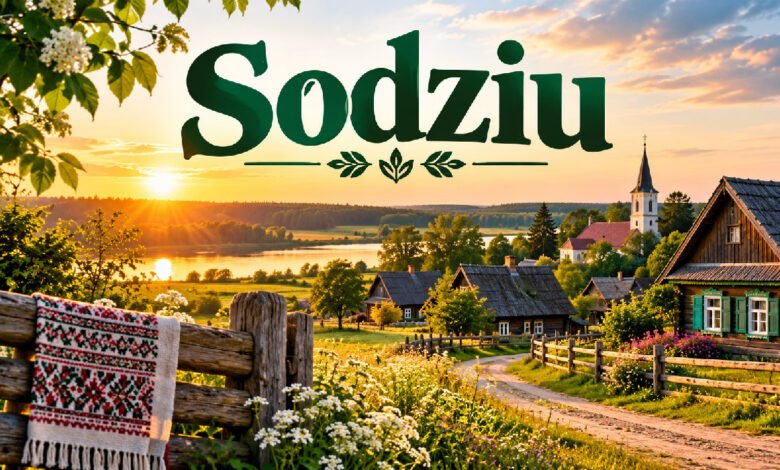
Sodziu is a term closely connected with Lithuanian village life, rural settlements, and cultural history. Online explanations can be confusing because Lithuanian spelling and grammar create several similar-looking words with very different meanings.
The strongest linguistic connection is with sodžius, an older Lithuanian word referring to a village or rural settlement. The spelling Sodziu commonly appears online when Lithuanian characters are simplified or when a grammatical form is written without the letter ž.
Understanding Sodziu therefore requires more than a quick translation. Its meaning becomes clearer through Lithuanian language, settlement history, agriculture, traditional homesteads, and the transformation of rural communities over several centuries.
This guide explains the meaning of Sodziu, its linguistic background, historical importance, traditional village life, and modern relevance. It also separates reliable meanings from claims that can result from confusing sodžius, sodžiu, sodyba, and žodžiu.
What Is Sodziu?
Sodziu is primarily associated with the Lithuanian word sodžius, meaning a village or rural settlement. Historically, the term could have a more specific connection with older agricultural communities rather than simply describing every modern village in Lithuania.
The spelling requires attention. Lithuanian uses the letter ž, pronounced approximately like the “s” in the English word “vision.” When diacritical marks are unavailable, people may type Lithuanian words using basic Latin letters instead.
That simplification helps explain why forms such as sodziu and sodzius appear in search results. However, removing Lithuanian characters can make separate words look deceptively similar, so spelling and surrounding context are important when determining the intended meaning.
Sodziu should therefore not automatically be treated as a lifestyle, organization, technology, or individual place. Unless a particular brand uses the name, its most useful interpretation comes from Lithuanian vocabulary associated with villages, settlements, and countryside history.
Sodziu Meaning in Lithuanian
The basic form sodžius refers to a village or settlement and has particularly strong historical associations with Lithuania’s countryside. Depending on the period and linguistic context, English translations may use terms such as village, rural settlement, or peasant settlement.
Lithuanian is an inflected language. This means nouns can change their endings according to their grammatical function. Consequently, readers can encounter sodžius and related forms rather than seeing exactly the same spelling in every Lithuanian sentence.
The form sodžiu can occur as an inflected form of sodžius. Once the Lithuanian character ž is replaced by a plain “z,” sodžiu becomes sodziu, producing the exact keyword frequently encountered on English-language websites and searches.
This distinction matters because Sodziu is not necessarily an independent Lithuanian dictionary headword spelled exactly that way. It is better understood by restoring the Lithuanian spelling and then examining the grammatical form and context in which the word originally appeared.
Why Sodziu Is Often Misunderstood
One major source of confusion is the loss of Lithuanian diacritics. Search engines, domain names, older computer systems, international keyboards, and casual online writing may replace ž with “z,” making the original spelling less obvious to non-Lithuanian readers.
Another problem involves žodžiu, a completely different Lithuanian word. It is related to žodis, meaning “word,” and žodžiu can be used conversationally in senses resembling “in a word,” “in short,” or “basically,” depending on context.
When Lithuanian spelling is preserved, sodžiu and žodžiu are visibly different. Once special characters are removed, however, unfamiliar readers can easily overlook the distinction and combine definitions belonging to separate words.
This explains why some online pages attach conversational meanings to Sodziu while others describe villages and rural heritage. For research involving settlements or Lithuanian countryside history, the relevant linguistic family is sodžius, not the unrelated word žodžiu.
Sodziu, Kaimas, and Sodyba
Several Lithuanian terms can describe aspects of countryside life, but they should not be treated as perfect synonyms. Sodžius is associated with a village or rural settlement and can carry an older historical character when discussing traditional settlement patterns.
Kaimas is a common modern Lithuanian term for a village or countryside settlement. In general explanations, sodžius and kaimas can overlap semantically, although historical usage and context may create distinctions between them.
Sodyba refers more specifically to a homestead, farmstead, or country property. A sodyba can include a house, yard, garden, agricultural buildings, and surrounding land rather than representing an entire village community.
The simplest distinction is therefore based on scale and context. A sodyba normally describes an individual rural property, while sodžius and kaimas can describe larger settlements. Exact translations still depend on historical period, grammatical usage, and source context.
Historical Sodziu Settlements
Older Lithuanian rural settlements developed around agriculture because families depended directly on fields, livestock, forests, meadows, and accessible water. A community’s physical organization therefore reflected practical needs rather than modern ideas about symmetrical streets or planned residential neighborhoods.
Historical settlements were not identical throughout Lithuania. Geography, regional traditions, land ownership, agricultural practices, and natural features influenced where buildings appeared and how families accessed their fields, grazing areas, forests, and neighboring properties.
Some older settlement forms could be irregular or dispersed. Houses and agricultural structures were not necessarily arranged in perfectly straight lines. Rivers, hills, forests, roads, and productive farmland could all influence the position and shape of individual homesteads.
This historical background gives sodžius more significance than a simple English translation can convey. The term provides a window into Lithuania’s agrarian past and the relationship between settlement patterns, farming households, land organization, and developing rural communities.
How Land Reform Changed Villages
A major transformation occurred during the 16th-century Valak, or Valakas, land reform, associated with large-scale reorganization of agricultural land in the Grand Duchy of Lithuania. The changes affected farming arrangements, land measurement, taxation, and village organization.
Instead of preserving every older settlement pattern, reform could reorganize households and agricultural holdings into more regular arrangements. In affected areas, this contributed to the development of villages whose farmsteads followed clearer spatial patterns than many earlier dispersed communities.
Such changes were significant because settlement structure directly affected rural life. The location of homes, fields, roads, farm buildings, and communal areas influenced how residents traveled, farmed, communicated, and managed their agricultural responsibilities.
Over time, older settlement terminology also evolved. Sodžius continued to carry the broader idea of countryside settlement even as the specific medieval patterns associated with Lithuanian rural communities changed through reforms, economic development, population movement, and modernization.
Homes and Buildings in Rural Lithuania
Traditional Lithuanian homesteads were practical spaces designed around household and agricultural requirements. Wood was historically important for rural construction because forests supplied accessible building material and generations of craftspeople developed knowledge for working with it effectively.
A developed farmstead could contain a dwelling house alongside barns, sheds, storage structures, animal buildings, gardens, fences, and yards. The exact combination depended on family resources, regional building traditions, farming activities, and the historical period involved.
Climate strongly influenced domestic life. Families needed heating during cold winters and suitable places for keeping grain, vegetables, preserved foods, equipment, and other necessities. Buildings therefore served both residential and productive functions within the agricultural household.
It is misleading, however, to describe one architectural plan as the universal “Sodziu house.” Lithuanian rural architecture changed across regions and centuries. Sodžius describes the settlement context rather than one standardized building design that every countryside family followed.
Farming and Seasonal Work
Agriculture formed the economic foundation of many traditional Lithuanian villages. Families cultivated grains and vegetables, managed gardens, kept livestock, collected natural resources, and performed numerous maintenance jobs necessary for sustaining households throughout the year.
Seasonal changes controlled much of this work. Spring brought preparation and planting, while summer demanded crop care, haymaking, and livestock management. Autumn centered heavily on harvesting and storing provisions before temperatures dropped and winter restricted agricultural activity.
Winter did not eliminate work. Animals still required feeding and care, while households repaired tools, processed stored products, prepared food, and completed indoor tasks. Rural survival depended on planning beyond the immediate growing season.
Crops and farming practices changed across locations and historical periods, so Sodziu should not be presented as one rigid agricultural system. The broader connection is that historical sodžiai belonged to an agrarian society where land shaped work, food, settlement, and community relationships.
Food in Lithuanian Village Life
Traditional countryside food was closely connected with locally available ingredients. Grain, vegetables, dairy products, meat, forest products, and eventually potatoes became important parts of Lithuanian food culture, although diets differed according to region, income, season, and historical period.
Rye has particular importance in Lithuanian culinary heritage, especially through dark rye bread. Dairy products, mushrooms, berries, vegetables, and preserved foods also demonstrate how rural households combined cultivated ingredients with resources collected from surrounding landscapes.
Food preservation was essential rather than fashionable. Families needed supplies to survive seasons when gardens and fields produced little fresh food. Drying, fermenting, smoking, salting, and cool storage helped extend the usefulness of different ingredients.
Popular Lithuanian dishes should not be marketed as a special “Sodziu cuisine.” Sodziu is associated with settlement and village history, not an officially defined cooking tradition. Traditional foods belong more accurately to Lithuanian national and regional culinary heritage.
Family and Community Life
A rural household depended on cooperation between family members. Adults and children performed responsibilities suited to their abilities, while practical knowledge about animals, crops, food, tools, and household work could pass naturally between generations through observation and participation.
Cooperation could also extend beyond individual households. Agricultural jobs, construction, celebrations, emergencies, and other demanding activities sometimes benefited from neighbors helping one another. Rural communities consequently created practical networks of relationships as well as geographic settlements.
Weddings, funerals, religious observances, seasonal occasions, and community gatherings created additional opportunities for social interaction. These events could strengthen family relationships and transmit customs, songs, stories, beliefs, and local practices between generations.
Community should not be romanticized as universally harmonious. Traditional countryside life involved difficult labor, economic pressures, social differences, and environmental uncertainty. Nevertheless, shared work and local relationships were important elements of how many historical Lithuanian rural communities operated.
Crafts, Songs, and Folk Traditions
Traditional rural households required skills extending far beyond farming. Woodworking, weaving, sewing, textile production, basket making, building maintenance, and tool repair could provide essential goods while allowing families to maintain objects that were expensive or difficult to replace.
Lithuania also possesses a rich tradition of folk songs known as dainos. Songs could accompany work, celebrations, family events, and other occasions, while their subjects included nature, love, family relationships, historical experiences, and everyday human concerns.
Stories, sayings, customs, and practical knowledge could be transmitted orally. Lithuania’s cultural heritage contains influences from older Baltic traditions as well as later Christian life, producing layers of beliefs and customs that varied considerably across communities and historical periods.
These traditions should be described as Lithuanian rural culture rather than a separate system invented by “Sodziu.” Sodžius identifies a village or settlement context; it is not the formal name of one craft, religion, folklore genre, or cultural philosophy.
Sodziu and Lithuanian Heritage
Today, the historical associations of sodžius can evoke more than settlement geography. Villages played an important role in preserving family histories, local speech, agricultural knowledge, songs, food traditions, architecture, and connections between generations.
For families whose ancestors left the countryside, rural places can also become symbols of origin and belonging. Old houses, church records, cemeteries, photographs, maps, and family stories may provide valuable clues when researching Lithuanian ancestry.
Museums, preserved buildings, cultural programs, and historic landscapes help document rural history. They allow modern audiences to understand agricultural communities without pretending that historical village life was always simple, peaceful, or environmentally ideal.
Sodziu therefore carries both linguistic and historical value. Its direct meaning remains associated with a rural settlement, while broader ideas about roots, memory, family, and heritage emerge from the cultural importance villages have held within Lithuanian society.
Sodziu and Sustainable Living
Traditional rural households often repaired belongings, reused materials, produced food locally, collected forest resources, and preserved seasonal ingredients. From a modern perspective, some of these practices resemble principles associated with resource conservation and sustainable living.
The motivation was not necessarily environmental ideology. Local production and reuse were frequently economic necessities created by limited resources, transportation, technology, and access to manufactured products. Historical behavior should therefore be interpreted within the conditions of its own period.
Modern people can still learn useful lessons from traditional practices. Repairing durable goods, reducing unnecessary waste, growing food, preserving seasonal produce, and understanding local ecosystems can complement contemporary approaches to more responsible resource use.
Calling Sodziu an ancient sustainability movement would nevertheless be inaccurate. Sodžius means a village or settlement, not a formal environmental philosophy. Sustainability is better described as a modern perspective through which certain historical countryside practices can be examined.
Sodziu in Modern Lithuania
Lithuanian villages have transformed significantly through industrialization, migration, political changes, improved transportation, mechanized agriculture, and digital technology. Contemporary rural communities cannot be understood simply as preserved versions of villages that existed several centuries ago.
Modern residents may farm, commute to cities, operate businesses, provide services, or work remotely. Electricity, vehicles, internet access, agricultural machinery, and renovated housing coexist with older buildings and landscapes in many countryside environments.
Some traditional farmsteads have become private homes, holiday properties, museums, accommodation businesses, or restored heritage sites. Rural tourism can introduce visitors to Lithuanian landscapes, food, architecture, crafts, saunas, farms, forests, rivers, and other countryside experiences.
These developments demonstrate that rural heritage can survive without freezing villages in the past. The meaning of sodžius remains historically valuable even as actual Lithuanian villages continue changing in response to modern economic, demographic, and technological conditions.
Common Myths About Sodziu
Sodziu is sometimes described online as a philosophy centered on community, spirituality, sustainability, or simple living. Those themes can certainly be associated with interpretations of countryside life, but they are not the established dictionary definition of sodžius.
Another misconception is that Sodziu means “basically” or “in short.” That interpretation generally results from confusion with žodžiu, the separate Lithuanian form connected with žodis, or “word.” Correct Lithuanian spelling helps expose the difference.
Sodziu should not automatically be identified as one particular village, textile method, ritual, food, app, company, or tourism program either. Businesses and creative projects can independently adopt similar names, but such usage does not redefine the Lithuanian term.
Reliable interpretation therefore starts with context. If a source discusses Lithuanian settlements, villages, agriculture, or countryside history, sodžius is probably relevant. If it discusses conversational language, another Lithuanian word—especially žodžiu—may actually be intended.
Why Sodziu Still Matters
Sodziu matters linguistically because it demonstrates how removing a single Lithuanian character can create considerable confusion. Restoring ž and examining grammatical endings can transform an unclear internet keyword into a term with an identifiable linguistic and historical background.
It matters historically because sodžius connects readers with the organization of rural Lithuania. Settlement patterns reveal how families interacted with farmland, natural resources, transportation routes, neighbors, political reforms, and economic systems over long periods.
The term also matters culturally. Lithuanian villages contributed to food traditions, folk culture, architecture, agriculture, family histories, and regional identities. Understanding their development offers a more realistic picture than treating Sodziu as an invented modern lifestyle concept.
For researchers, travelers, language learners, and people exploring Lithuanian ancestry, the word provides a useful starting point. The key is maintaining the distinction between its genuine linguistic meaning and broader cultural interpretations that have accumulated around rural life.
Final Thoughts
Sodziu is best understood through the Lithuanian word sodžius, meaning a village or rural settlement. The keyword can also represent sodžiu, an inflected grammatical form, when Lithuanian diacritics are removed in online writing.
Its historical importance comes from Lithuania’s agricultural communities and changing settlement patterns. Farming, homesteads, seasonal labor, food preservation, crafts, folk traditions, and community relationships provide context for understanding the world in which older sodžiai developed.
Modern associations with heritage, nature, sustainability, and simple living can enrich discussions about Lithuanian countryside culture. They should remain clearly separated, however, from the literal definition of the word and should not be presented as an ancient formal philosophy.
The most important distinction is equally simple: sodžius is connected with a village, while žodžiu is connected with “word.” Recognizing that difference makes Sodziu much easier to understand and prevents many of the misleading definitions circulating online.
(FAQs)
What does Sodziu mean?
Sodziu is mainly connected with the Lithuanian word sodžius, meaning a village or rural settlement. The spelling Sodziu can appear online when Lithuanian diacritics are removed.
Is Sodziu a Lithuanian word?
Sodziu represents a simplified spelling associated with Lithuanian sodžius or the grammatical form sodžiu. Correct interpretation depends on the original spelling and sentence.
What is the difference between sodžius and sodžiu?
Sodžius is the basic noun meaning village or rural settlement. Sodžiu is an inflected form of the same Lithuanian noun used according to grammatical context.
Is Sodziu the same as žodžiu?
No. Sodžiu is related to sodžius, meaning village. Žodžiu is related to žodis, meaning “word,” and can have conversational uses resembling “in short” or “basically.”
What is the difference between sodžius and sodyba?
Sodžius describes a village or settlement. Sodyba generally describes an individual homestead, farmstead, or country property containing a home and its associated land or buildings.
Is sodžius the same as kaimas?
Their meanings can overlap because both can refer to villages. Kaimas is a common modern Lithuanian term, while sodžius can carry stronger historical associations with older rural settlements.
Is Sodziu a lifestyle or sustainability movement?
No established linguistic meaning defines Sodziu as a formal lifestyle or environmental movement. Sustainability and simple living are modern associations that can be drawn from some traditional rural practices.
Why is Sodziu important today?
Sodziu remains useful for understanding Lithuanian vocabulary, rural history, settlement development, agriculture, cultural heritage, and family roots. It also illustrates why correct Lithuanian spelling and context are essential when interpreting unfamiliar words.





One Comment