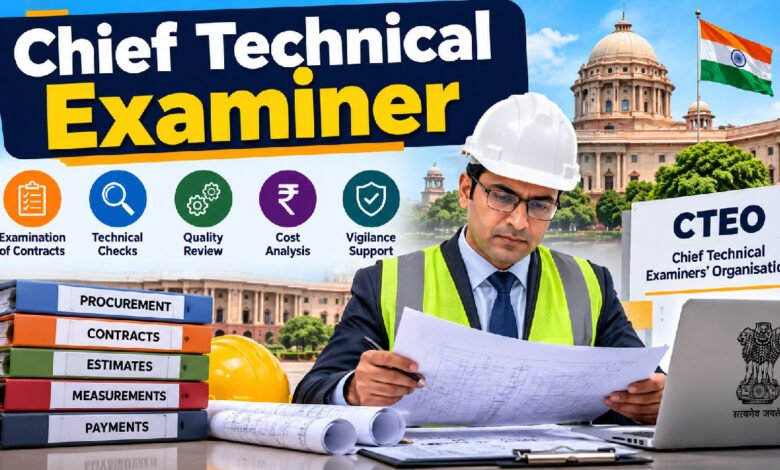
A chief technical examiner plays an important role in India’s public-sector vigilance and procurement framework. The position brings technical expertise into the examination of government contracts, helping authorities assess whether public projects, purchases, and services have been planned and executed properly.
The role is closely associated with the Chief Technical Examiners’ Organisation, commonly called CTEO, which functions as the technical wing of the Central Vigilance Commission. Its examinations can involve engineering works, procurement procedures, contract conditions, quality, measurements, costs, supplies, services, and payments.
Understanding this position requires more than knowing its title. This guide explains the Chief Technical Examiner’s responsibilities, CTEO’s history and structure, Intensive Examinations, contract selection, procurement checks, common irregularities, CTE and CVO differences, required skills, and importance in protecting public expenditure.
What Is a Chief Technical Examiner?
A Chief Technical Examiner (CTE) is a senior technical officer associated with the Chief Technical Examiners’ Organisation under India’s Central Vigilance Commission. The position provides specialist technical knowledge when vigilance matters involve engineering, procurement, contracts, project costs, specifications, quality, or other technical questions.
Unlike an engineer responsible for designing or supervising a particular government project, the CTE performs an examination function. The objective is to independently assess selected procurement cases and determine whether important technical, contractual, financial, and procedural requirements were appropriately followed.
The examination can cover much more than physical construction. Depending on the procurement involved, technical officers may examine estimates, tender requirements, rates, contract conditions, measurements, testing, supplies, equipment, bills, variations, acceptance records, and payments made by the concerned public organisation.
This makes the position important for accountability. Technical examination helps establish whether the organisation received the work, goods, equipment, or services required by its contract and whether payments and procurement decisions are supported by suitable records and technical justification.
What Is the Chief Technical Examiners’ Organisation?
The Chief Technical Examiners’ Organisation (CTEO) is the technical wing of the Central Vigilance Commission. It provides specialist assistance for examining procurement and contractual matters that require engineering, technical, costing, measurement, quality-control, or related professional expertise.
Its scope can include civil and horticultural works, electrical and mechanical projects, purchases and supplies, information technology procurement, consultancy, transportation, equipment, and services. Therefore, CTEO should not be understood simply as an organisation that inspects government buildings.
Technical examination may cover different stages of procurement. Officers can study planning documents, estimates, technical approvals, tender conditions, contract agreements, execution records, quality documentation, measurements, variations, invoices, payments, completion information, and other evidence relevant to the selected case.
CTEO also contributes to preventive vigilance. When an examination identifies a recurring weakness in tender preparation, documentation, testing, cost control, or contract administration, the lessons can help organisations improve future procurement instead of addressing only the individual contract already examined.
History and Development of CTEO
The Chief Technical Examiners’ Organisation dates back to 1957, when it was established under the then Ministry of Works, Housing and Supply. Its early responsibilities were strongly associated with technical examination of works handled by the Central Public Works Department.
The organisation developed as India strengthened mechanisms for financial control and vigilance in public administration. The Santhanam Committee’s work on corruption prevention contributed to the development of stronger vigilance arrangements and supported a wider role for technical examination of government expenditure and works.
In 1964, CTEO came under the administrative control of the Central Vigilance Commission. A second Chief Technical Examiner position was subsequently created in 1979, reflecting the expanding volume and technical diversity of government projects and procurement requiring examination.
Its work has continued to evolve alongside public procurement. Government organisations now procure software, technology, machinery, specialised equipment, consulting expertise, transportation, professional services, and complex systems in addition to traditional construction, making multidisciplinary technical examination increasingly important.
Main Responsibilities of a Chief Technical Examiner
One major responsibility is examining the technical and financial foundation of selected procurement. Project estimates may be studied to determine whether quantities, rates, specifications, and assumptions have reasonable support. Weak initial estimates can contribute to later cost increases and contractual difficulties.
Tendering can also receive detailed attention. Examiners may review specifications, eligibility requirements, bidding conditions, comparative information, evaluation procedures, and award decisions. Unnecessarily restrictive requirements can be significant because they may reduce genuine competition without sufficient technical justification.
During contract execution, records can be compared with contractual requirements and actual performance. Depending on the project, this may include measurements, drawings, materials, workmanship, tests, equipment, quantities, variations, additional items, approvals, delivery records, and completion or acceptance documentation.
Payments are another significant area. Bills should correspond with contractual rates and properly supported work, goods, or services. Technical examination can therefore help identify questionable quantities, unsupported changes, quality deficiencies, excess payments, or other matters requiring explanation from the organisation concerned.
What Types of Procurement Can Be Examined?
Civil works remain an important category of technical examination. Buildings, infrastructure, maintenance, and related projects can require checks involving estimates, drawings, quantities, materials, site conditions, measurement records, testing, workmanship, variations, progress, completion, and payments made against executed work.
Electrical and mechanical contracts require different expertise. Technical teams may examine equipment specifications, installation requirements, testing, performance, quantities, contractual standards, acceptance procedures, and payments to determine whether supplied or installed systems correspond with the approved procurement requirements.
The scope can also extend to purchases and supply contracts. Machinery, technical equipment, materials, and other goods may require examination of specifications, tender conditions, prices, quantities, inspection reports, delivery documentation, testing results, warranties, acceptance, and payment records.
Modern procurement additionally includes IT systems, consultancy, transportation, and other services. In these cases, examination may focus more heavily on scope, eligibility conditions, deliverables, service levels, milestones, acceptance criteria, contract modifications, supporting records, and whether payments correspond with agreed outputs.
What Is a CTE Intensive Examination?
An Intensive Examination is a detailed technical examination of a selected procurement case. Instead of merely confirming that documents exist, technical officers can study how important decisions were made and whether the available records, contractual requirements, and actual execution are consistent.
For a construction contract, the process may involve studying estimates, tender documents, drawings, agreements, measurement records, test reports, bills, and approvals. A physical inspection may provide additional evidence about quantities, materials, workmanship, progress, or compliance with technical requirements.
The approach changes with the procurement category. Equipment may require specification and acceptance checks, while an IT or consultancy contract can require examination of agreed deliverables, milestones, performance requirements, approvals, service conditions, acceptance documentation, and payments against completed obligations.
An observation raised during an examination is not automatically evidence of corruption. Differences can arise from errors, inadequate records, poor administration, technical decisions, or contractual disagreements. Findings need proper examination, supporting evidence, explanations, and follow-up before stronger conclusions can reasonably be reached.
How Contracts Are Selected for Examination
CTEO cannot intensively examine every procurement transaction carried out by organisations falling within the relevant vigilance framework. Its resources must therefore be directed toward selected contracts where technical examination is considered useful based on available information, priorities, and identified risks.
Quarterly Progress Reports, commonly known as QPRs, have historically been an important source of procurement information for the examination system. They provide information concerning qualifying procurement activities and can help technical authorities identify contracts that may warrant closer scrutiny.
Factors such as procurement value, technical nature, importance, risk, delays, substantial cost changes, or other notable circumstances can influence examination priorities. Complaints concerning a contract can also create a reason for closer technical scrutiny when the allegations involve matters requiring specialist assessment.
Selection itself should not be interpreted as proof of misconduct. A project may be examined because of its size, technical complexity, category, risk profile, or examination priorities. The purpose of selection is to establish facts rather than assume wrongdoing beforehand.
How the Technical Examination Process Works
Examination can begin with planning. Officers may study estimates, specifications, quantities, technical sanctions, approvals, and supporting calculations. This stage is important because unclear requirements or poorly supported costs can create tendering, execution, payment, and quality problems later.
Tender documentation provides another major examination area. Eligibility conditions, technical requirements, bidding procedures, evaluation, rates, and award decisions can be reviewed. The examination may consider whether the stated procurement requirements were applied consistently and whether competition was unnecessarily restricted.
During execution, contractual requirements can be compared with records and actual performance. Technical teams may examine measurements, materials, tests, drawings, quantities, equipment, approved changes, delays, progress records, and other information appropriate to the particular work, purchase, or service.
Finally, bills and acceptance documentation may be reviewed against contract requirements. The objective is to establish whether payments have adequate support and whether the procuring organisation received the required quantity, quality, equipment, deliverables, or services before relevant payments and acceptance.
Common Issues Identified in Technical Examination
Poorly prepared estimates are one possible concern. Quantities may lack adequate calculations, rates may have weak justification, or specifications may not clearly represent actual requirements. Such weaknesses can affect competition, contract prices, project management, and subsequent financial control.
Tender conditions can create another problem. Requirements that are excessively narrow without valid technical reasons may restrict competition. Similarly, inconsistent bid evaluation, unclear specifications, unexplained deviations, or poorly documented procurement decisions can create issues requiring further examination.
Execution-related observations can include inadequate workmanship, non-compliant materials, missing tests, measurement differences, unauthorised variations, unsupported additional items, or incomplete records. Such matters become especially important when they affect quality, contractual obligations, safety, quantities, or the amount ultimately paid.
Financial observations can involve incorrect rates, excess quantities, unsupported bills, duplicate payments, or payments inconsistent with actual delivery or execution. However, every discrepancy requires examination on its own evidence; a technical or financial irregularity alone does not establish dishonest intent.
What Happens After an Intensive Examination?
Important findings from an Intensive Examination are documented through the prescribed examination and reporting process. Observations should have a clear factual and technical foundation so the organisation concerned can understand what was identified and why the issue requires explanation or corrective attention.
After appropriate review, observations may be communicated to the concerned organisation through its vigilance mechanism, including the Chief Vigilance Officer where applicable. The organisation can then provide records, explanations, clarifications, or details of corrective action relevant to the observations raised.
Some observations may be resolved after satisfactory clarification. Others can require recovery of an excess payment, correction of defective work, improvement in procedures, further verification, contractual action, or additional vigilance consideration depending on the facts and applicable rules.
CTEO’s technical examination function should also be distinguished from criminal investigation. Technical findings can provide valuable evidence or specialist assistance in vigilance matters, but CTEO itself does not simply replace agencies that possess separate statutory criminal-investigation responsibilities.
Chief Technical Examiner vs Chief Vigilance Officer
A Chief Technical Examiner primarily brings technical expertise to procurement and contract examination. The work can involve engineering, specifications, estimates, tender conditions, quantities, measurements, quality, contract variations, equipment, project execution, and financial implications connected with technical findings.
A Chief Vigilance Officer (CVO) has a broader vigilance-coordination role within the organisation concerned. The CVO deals with vigilance matters and acts as an important institutional link in handling observations, obtaining responses, following up cases, and supporting preventive vigilance activities.
The two roles can therefore interact closely without being interchangeable. CTEO may identify technical observations requiring clarification, while the CVO can coordinate the concerned organisation’s response and subsequent vigilance-related action according to the applicable procedures and circumstances.
CTE-type examinations may also be conducted through organisational vigilance mechanisms under the applicable CVC framework. This extends technical vigilance coverage because a central technical organisation cannot itself physically examine every significant government procurement transaction occurring across numerous public bodies.
Chief Technical Examiner and Preventive Vigilance
Technical vigilance is valuable not only after money has been spent. Examination findings can reveal weaknesses in procurement systems themselves. Repeated problems involving specifications, estimates, bidding, measurements, testing, or approvals may indicate that organisational procedures need improvement.
For example, repeated quality failures may suggest weak testing requirements rather than one isolated contractor problem. Frequent variations could indicate inadequate planning. Similar excess-payment observations across projects might reveal deficiencies in measurement, bill verification, supervision, or internal financial controls.
Correcting these systemic weaknesses is the essence of preventive vigilance. Better tender documents, transparent eligibility requirements, reliable estimates, clear approval trails, proper testing, accurate measurements, and stronger contract-management systems can reduce opportunities for irregularities before they produce larger losses.
This preventive function also benefits honest procurement officials and contractors. Clear rules, complete records, objective specifications, and documented decisions reduce ambiguity. They make procurement easier to administer, audit, defend, and examine while supporting greater consistency in the treatment of participating bidders.
Skills Needed for a Chief Technical Examiner
Strong engineering and technical competence is fundamental because complex procurement cannot always be understood from administrative documents alone. An examiner needs the ability to interpret specifications, estimates, drawings, measurements, technical standards, testing information, project records, and contractual performance evidence.
Knowledge of public procurement and contract management is equally important. A technically sound product can still involve procurement problems if bidding, evaluation, variations, acceptance, or payments were improperly handled. Examiners therefore need to understand both engineering questions and procurement processes.
Analytical judgement and evidence-based reporting are also essential. An examiner must separate minor errors from significant observations and explain technical findings clearly. Conclusions should rely on contracts, records, measurements, tests, approvals, applicable requirements, and other relevant evidence rather than unsupported assumptions.
Modern government procurement also demands broader expertise. IT platforms, specialised machinery, cloud services, consultancy, medical equipment, transportation, and complex technical systems can require domain specialists. Effective examination therefore increasingly depends on multidisciplinary knowledge rather than traditional civil-engineering expertise alone.
Why the Chief Technical Examiner Is Important
Government procurement involves public money, so weaknesses can affect both taxpayers and public services. Poor specifications, inflated estimates, defective materials, incorrect measurements, weak competition, and unjustified payments can increase costs while reducing the quality or usefulness of government projects.
The chief technical examiner provides an important layer of specialist scrutiny. Technical examination can connect paperwork with physical or contractual reality, helping determine whether recorded quantities, claimed quality, supplied equipment, completed deliverables, and payments are supported by appropriate evidence.
The role also strengthens accountability without assuming every discrepancy represents corruption. This distinction matters because technical errors, administrative weaknesses, contractual disagreements, and deliberate misconduct are different problems. Proper examination helps establish facts before determining what response may be appropriate.
Ultimately, technical vigilance supports better public procurement. When organisations improve estimating, tendering, documentation, testing, measurement, approval, and payment controls, they reduce avoidable risks while making government expenditure more transparent, defensible, economical, and easier to scrutinise.
Final Thoughts
A chief technical examiner performs a specialised role at the intersection of engineering, public procurement, contract management, and vigilance. Through CTEO, technical expertise can be applied to selected government contracts where ordinary administrative or financial examination may not reveal the complete picture.
The work can cover construction, equipment, supplies, electrical and mechanical projects, IT procurement, consultancy, transportation, and services. Depending on the case, examination may consider planning, estimates, specifications, competition, contract award, execution, measurements, testing, quality, variations, acceptance, and payments.
Its value extends beyond detecting individual irregularities. Technical findings can reveal weaknesses in procurement systems and encourage better estimating, clearer tender requirements, stronger documentation, improved quality control, transparent approvals, accurate measurement, and more disciplined management of public contracts.
A CTE observation should therefore be understood as a technical finding requiring appropriate consideration, not automatic proof of corruption. Evidence, explanations, applicable rules, and the circumstances of each case are necessary before determining whether corrective, vigilance, contractual, or other action is justified.
(FAQs)
What is the full form of CTE?
CTE stands for Chief Technical Examiner. In the CVC context, the role involves specialist technical examination of selected government procurement and contracts, including areas such as engineering, specifications, costs, measurements, quality, and payments.
What is CTEO in India?
CTEO stands for Chief Technical Examiners’ Organisation. It functions as the technical wing of India’s Central Vigilance Commission and provides specialist technical support for examination of selected public procurement, contracts, works, goods, and services.
What does a Chief Technical Examiner do?
A Chief Technical Examiner oversees or supports technical examination of selected procurement cases. The work may involve estimates, tender conditions, specifications, contract terms, measurements, quality, testing, variations, bills, payments, equipment, supplies, and project documentation.
What is an Intensive Examination by CTEO?
An Intensive Examination is a detailed technical review of a selected procurement case. Depending on the contract, it can involve examining procurement documents, technical records, measurements, quality evidence, contractual compliance, payments, and physical work or delivered items.
Does a CTE observation prove corruption?
No. An observation identifies an issue that requires consideration or explanation. It may result from technical errors, weak documentation, administrative failures, contractual issues, or other causes. Evidence and further examination are needed before determining misconduct.
What is the difference between a CTE and a CVO?
A CTE specialises in technical and procurement examination, while a Chief Vigilance Officer coordinates vigilance activities within an organisation. CTEO findings and CVO functions can interact during clarification, follow-up, preventive vigilance, and further examination.
Does CTEO examine only construction projects?
No. Its scope is broader than civil construction. Depending on the applicable framework, technical examination can cover electrical and mechanical works, supplies, equipment, IT procurement, consultancy, transportation, services, and other government procurement activities.
Why is technical examination important in government procurement?
Technical examination helps determine whether public money corresponds with properly procured and delivered work, goods, or services. It can expose weak specifications, quality problems, incorrect measurements, unsupported changes, payment issues, and procurement-system weaknesses requiring improvement.