

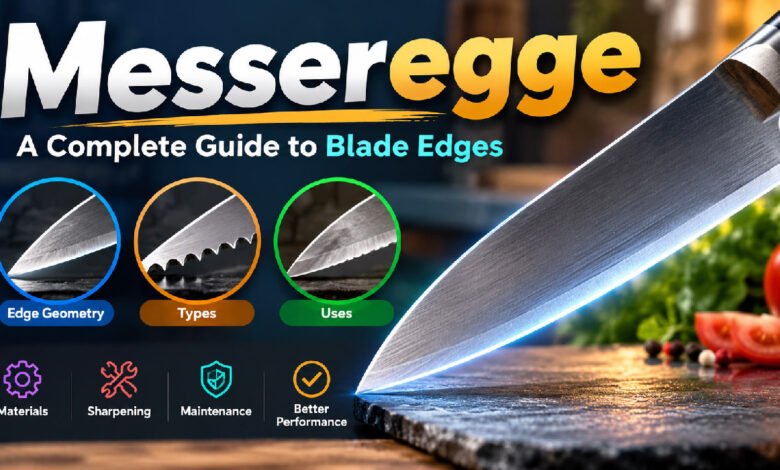
Messeregge is a term people may encounter online when researching knife edges, blade geometry, sharpening, and cutting performance. In this context, it is generally used to describe or discuss the sharpened working edge of a knife or another cutting blade.
Understanding the cutting edge matters because sharpness alone does not determine blade quality. Edge angle, thickness, steel hardness, grind style, surface condition, and intended use all influence how efficiently a blade moves through food, wood, fibers, plastics, or other materials.
This guide explores Messeregge from a practical blade-edge perspective. It explains the terminology, edge geometry, common grind styles, blade materials, sharpening methods, industrial applications, maintenance, safety, and the factors that help users choose a suitable cutting edge for a particular task.
What Does Messeregge Mean?
Messeregge appears online as a term connected with knives and cutting edges. However, it should not be treated as the normal technical German word for a knife edge. In standard German blade terminology, Messerschneide or simply Schneide is commonly used for the sharpened cutting portion.
This distinction is useful when researching the subject. A person searching for Messeregge may actually want information about knife-edge geometry, sharpening angles, edge retention, bevels, grinds, or the general construction of a cutting edge rather than a special blade technology called Messeregge.
In practical terms, the subject concerns the narrow working area where a blade meets the material being cut. Its design can greatly influence cutting resistance, precision, durability, sharpening requirements, and the amount of force a person or machine must apply during cutting.
How a Blade Cutting Edge Works
A cutting edge concentrates force into a very small area. When pressure is applied, this narrow edge enters or separates the material. A thinner and sharper edge generally requires less force, although its real performance also depends on blade geometry and material properties.
The blade behind the edge is equally important. A very sharp apex combined with a thick blade may still create considerable resistance when passing through dense material. For this reason, knife designers consider both the immediate cutting edge and the overall cross-section of the blade.
Cutting performance also changes as an edge wears. Microscopic deformation, abrasion, rolling, or chipping can make an edge feel dull even when damage is difficult to see. Regular maintenance restores the edge so that it can concentrate cutting force effectively again.
Why Edge Geometry Is Important
Edge geometry describes the physical shape of the cutting area. Important features include the bevel angle, thickness behind the edge, grind profile, and final apex. These characteristics determine how the blade interacts with whatever material it is expected to cut.
Fine geometry can reduce resistance and provide excellent slicing performance. This is useful for many kitchen, craft, and precision applications. However, making an edge extremely thin can reduce its ability to tolerate impact, twisting, hard materials, or other demanding working conditions.
More robust geometry places additional material behind the cutting edge. This can improve resistance to deformation and damage, although cutting resistance may increase. Good blade design therefore involves balancing cutting efficiency with the strength required for the tool’s intended working environment.
Thin and Thick Cutting Edges
Thin cutting edges are commonly associated with precision work because they can move through suitable materials with relatively little resistance. Kitchen slicing knives and some precision tools benefit from thin geometry when smooth, controlled cuts are more important than resistance to heavy impacts.
A thicker edge provides greater structural support near the cutting area. Such geometry may be preferable for tools exposed to harder materials, repeated impacts, rough handling, or demanding industrial operations. Greater thickness, however, does not automatically mean that a blade is better.
The correct choice depends on application rather than maximum sharpness or maximum strength. Using delicate geometry for abusive work can damage the edge, while unnecessarily thick geometry can make fine cutting inefficient. Matching the edge to its job produces more useful and predictable performance.
Common Types of Blade Grinds
A flat grind gradually reduces blade thickness toward the cutting edge. Different versions of flat grinding are widely used because the geometry can provide an effective balance of cutting ability, strength, manufacturing practicality, and ease of maintenance across many knife designs.
A hollow grind curves inward toward the edge and can create relatively thin cutting geometry. A convex grind curves outward and leaves more material supporting the edge. These profiles behave differently, making each suitable for particular tools and cutting requirements.
Another important design is the single-bevel edge, where geometry is strongly formed on one side. Certain specialized kitchen and woodworking tools use this approach. There is no universal best grind; performance depends on steel, thickness, sharpening, material being cut, and intended use.
Messeregge in Kitchen Knives
Kitchen knives demonstrate clearly why cutting-edge design matters. A knife used to slice vegetables, meat, herbs, or fish should pass through food cleanly without requiring unnecessary pressure. Thin geometry can therefore provide major benefits in many food-preparation tasks.
Different kitchen knives still require different properties. A fine slicing knife has different demands from a heavy knife intended for tougher work. Blade profile, steel, edge geometry, food type, cutting board, sharpening technique, and user habits can all influence long-term performance.
Maintaining kitchen edges is also important for control. A dull knife may encourage the user to apply excessive force, making cutting less predictable. Appropriate sharpening, suitable cutting surfaces, careful cleaning, and protected storage help preserve the edge and improve everyday usability.
Messeregge in Woodworking and Crafts
Woodworking tools rely heavily on controlled edge geometry. Chisels, carving knives, plane irons, and related tools need edges capable of separating wood fibers accurately. The appropriate geometry varies according to tool design, wood hardness, cutting direction, and the type of work.
A very fine edge can provide excellent results during detailed carving or finishing, but it must still have enough support to resist damage. Hard knots, incorrect technique, contact with metal, or excessive sideways pressure can quickly harm a delicate woodworking edge.
Craft knives and other precision cutters follow similar principles. Users need enough sharpness for clean, predictable cuts while maintaining adequate durability. Proper sharpening becomes especially important because changing the original bevel geometry can alter how the tool behaves during detailed or repetitive work.
Industrial and Professional Cutting Applications
Industrial blades operate under conditions very different from ordinary household knives. They may repeatedly cut paper, film, packaging, fibers, plastics, food products, rubber, textiles, or other production materials. Consistency and service life can be as important as initial sharpness.
Manufacturers can optimize industrial cutting edges for specific machinery, cutting speeds, loads, materials, and replacement schedules. Edge geometry, tool steel, heat treatment, surface finish, tolerances, and coatings may all be selected according to the requirements of the production process.
Professional cutting systems also require controlled maintenance. An edge that becomes damaged or excessively worn may lower cut quality, increase machine load, create inconsistent products, or interrupt production. Monitoring blade condition can therefore form an important part of efficient manufacturing operations.
Blade Materials and Edge Performance
Steel selection has a major effect on how a blade edge behaves. Important properties can include hardness, toughness, corrosion resistance, wear resistance, and ease of sharpening. Improving one characteristic may involve compromises elsewhere, which is why no blade steel is perfect for everything.
Heat treatment is just as significant as the name of the steel. Heating and cooling processes are carefully controlled to develop desired mechanical properties. Two blades made from similar steel can perform differently when their heat treatment, edge geometry, manufacturing quality, or intended applications differ.
Other cutting materials are also used in specialized situations. Ceramics and very hard tool materials can offer strong wear resistance but may have different toughness and sharpening requirements. Material selection should therefore be considered together with geometry rather than judged by hardness alone.
Modern Blade Manufacturing Technology
Modern manufacturing can produce cutting edges with a high level of repeatability. CNC machining, precision grinding, automated sharpening systems, controlled heat treatment, and advanced inspection equipment help manufacturers maintain dimensions and edge profiles across large numbers of blades.
Grinding remains fundamental because it removes material and forms the required blade geometry. The process must control factors such as heat and material removal. Excessive heat during inappropriate grinding can potentially affect the condition of the steel close to the cutting edge.
Some professional blades also use surface treatments or coatings to address wear, friction, or corrosion. Titanium nitride and diamond-like carbon are examples used in certain tooling applications. Their value depends on the blade system, coating process, substrate, edge design, and operating conditions.
Sharpness and Edge Retention Are Different
Sharpness describes how effectively an edge cuts at a particular moment. Edge retention describes how well useful cutting performance is maintained through use. A blade can be extremely sharp immediately after sharpening without necessarily keeping that level of performance for a long period.
Retention is influenced by several interacting factors. Steel composition, hardness, toughness, edge angle, blade thickness, abrasive materials, cutting surfaces, heat treatment, and the type of cutting performed can all affect how quickly an edge loses its effective working condition.
This explains why choosing a blade based only on initial sharpness can be misleading. A practical tool needs an appropriate combination of cutting ability, durability, maintainability, corrosion resistance, and edge stability. The best balance depends on what the blade actually needs to accomplish.
How to Sharpen a Messeregge Correctly
Sharpening restores cutting geometry by removing controlled amounts of material. Common systems include sharpening stones, guided abrasive systems, ceramic sharpeners, and suitable powered equipment. The correct method depends on blade material, edge profile, damage level, and the user’s sharpening experience.
Maintaining a consistent angle is important. Removing too much material or dramatically changing the bevel can alter edge performance. Coarse abrasives are normally more suitable for significant repair, while progressively finer abrasives can refine an edge after the required geometry has been established.
Sharpening and honing should also be distinguished. Depending on the blade and system, honing may maintain or refine an existing edge without performing the same level of material removal as full sharpening. Users should follow appropriate procedures for their particular knife or cutting tool.
How to Maintain a Blade Edge
Good maintenance begins with using a blade for its intended purpose. A fine kitchen knife should not be treated as a pry bar, screwdriver, or chopping tool for inappropriate hard materials. Side loading and impact can damage edges designed mainly for controlled slicing.
Cleaning and storage also affect blade condition. Moisture, corrosive substances, contact with other metal objects, and careless storage can harm some blade materials. Knife blocks, sheaths, racks, or suitable protective holders can reduce unnecessary contact with the sharpened edge.
Cutting surfaces matter as well. Very hard surfaces can accelerate edge wear on kitchen knives. Regular inspection helps identify dullness, rolling, corrosion, or chips before problems become severe. Appropriate maintenance usually requires less effort than restoring a badly damaged cutting edge.
How to Choose the Right Messeregge
Start by identifying the actual cutting task. Consider whether the blade will slice food, carve wood, process packaging, cut fibers, perform craft work, or operate inside industrial equipment. The target material and working conditions provide the foundation for selecting suitable edge geometry.
Next, consider the balance between cutting efficiency and durability. Fine geometry can be excellent for controlled slicing, while tougher work may need greater support behind the edge. Steel properties, heat treatment, blade thickness, grind style, and maintenance requirements should be considered together.
Finally, think about how the blade will be maintained. An edge that performs exceptionally but requires specialized sharpening may not suit every user. A practical Messeregge should offer the required cutting performance while remaining durable, safe, maintainable, and appropriate for its intended environment.
Common Mistakes With Blade Edges
One common mistake is assuming that a smaller sharpening angle is always better. Lower angles can improve cutting ability in suitable circumstances, but reducing an angle too far for the steel and application may make the edge vulnerable to rolling, deformation, or chipping.
Another mistake is using the wrong tool for the material. Cutting hard objects with a fine slicing knife, twisting a blade while it is embedded, or striking inappropriate surfaces can damage even high-quality edges. Blade quality cannot compensate for consistently unsuitable use.
Users may also sharpen too aggressively. Removing unnecessary material shortens blade life and can change its geometry. Sharpening should restore useful cutting performance rather than remove as much steel as possible. Correct technique, suitable abrasives, and consistent geometry generally produce better results.
Safety and Cutting Edge Performance
A properly maintained blade can offer better control because the user does not need to compensate for poor cutting performance with excessive force. However, every sharp blade can cause serious injury, so good edge condition must always be combined with responsible handling.
Users should cut in a controlled direction, keep hands away from the cutting path, use stable working surfaces, and store sharp tools securely. Industrial environments may require additional machine guards, procedures, protective equipment, inspections, and training appropriate to the particular cutting system.
Safety also includes recognizing blade damage. Chips, cracks, loose handles, damaged machinery, or severely altered edges can make cutting unpredictable. A cutting tool should be inspected and repaired, sharpened, or replaced when its condition makes normal operation unreliable or unsafe.
Final Thoughts
Messeregge is best understood online as a search term associated with the cutting edge of a knife or blade, rather than as the standard German technical name for that component. Standard blade terminology more commonly refers to the sharpened portion as the cutting edge or Schneide.
The important concept behind the search is blade-edge engineering. Geometry, bevel angle, grind, steel, heat treatment, thickness, sharpening, and working conditions combine to determine whether an edge is optimized for precise slicing, woodworking, crafts, manufacturing, or heavier cutting tasks.
No single edge design is ideal for every application. The most effective approach is to match blade geometry and material properties to the intended task, then maintain the edge correctly. This balance provides efficient cutting, predictable performance, reasonable durability, and safer everyday use.
(FAQs)
What is Messeregge?
Messeregge is an online search term associated with the sharpened cutting edge of a knife or blade. In standard German, Schneide or Messerschneide is more commonly used when referring specifically to a knife’s cutting edge.
Is Messeregge a German word for knife edge?
It should not be treated as the standard German technical term for a knife edge. German normally uses Messerschneide for a knife’s cutting edge, while Schneide can describe the cutting edge of a blade or cutting tool more generally.
Why is blade edge geometry important?
Edge geometry influences cutting resistance, precision, durability, and edge stability. Thin geometry often improves slicing performance, while stronger geometry can better tolerate demanding work. The correct design depends on the blade material and its intended cutting task.
What is the best angle for a blade edge?
There is no single best angle for every blade. Suitable geometry depends on the steel, blade thickness, cutting material, tool design, and expected workload. Fine cutting and heavy-duty work normally require different balances between sharpness and durability.
What makes a knife stay sharp longer?
Edge retention depends on several factors, including steel properties, heat treatment, edge geometry, cutting material, sharpening quality, and how the knife is used. Proper storage and suitable cutting surfaces can also help reduce unnecessary edge wear.
How often should a Messeregge be sharpened?
A blade should be sharpened when its cutting performance has noticeably declined rather than according to one fixed schedule. Frequency depends on usage, blade material, edge geometry, cutting surface, sharpening method, and the materials being cut.
Are blade coatings such as TiN and DLC useful?
Titanium nitride and diamond-like carbon coatings can provide useful properties such as wear resistance or reduced friction in appropriate applications. Their effectiveness depends on coating quality, substrate material, blade geometry, manufacturing process, and actual working conditions.
What is the difference between sharpness and edge retention?
Sharpness describes how effectively a blade cuts at a given time. Edge retention describes how long it maintains useful cutting performance. A blade can become extremely sharp after sharpening yet lose that sharpness relatively quickly during demanding use.





One Comment